Reasons to love the European School Heraklion #1

#1 It is a European school, which follows a European curriculum and is open to children from across the continent.

Yes, I know. At the moment many people would say this is a reason to hate the school. We all know about the failures of Europe — the bureaucracy, the lack of solidarity, the way that European institutions have been used to benefit some nations over others.

But this isn’t a reason to give up on Europe. Things won’t get better if we return to the nationalistic outlooks that fostered two great European wars. Rather, we need to build a new Europe — a Europe founded on genuine mutual understanding, respect, and support, whose institutions are flexible and sensitive, drawing on local strengths and supporting local needs, and where national cultures, traditions, and experiences are valued and shared.’

How could we create such a Europe?’ you may ask. Well, maybe by schooling children from different European countries together, in schools where they learn about each other’s culture and traditions, share their experiences and hopes, and learn to think of other European countries not as rival nations but as the homes of their friends. By bringing up young Europeans to be proud of their own country but also proud to belong to a wider family of nations with a shared history and shared ideals.

Is this idealistic? Yes, definitely! But kids are naturally idealistic and we should foster their idealism — and learn from it ourselves. We need the SEEH and more schools like it. Greece needs them. Europe needs them.

Maria K.

To the streets once again

Today I once again marched with students, parents, and teachers of the School of European Education Heraklion, which is again under threat. I took the posters that my dear friend Aglaia Michelakis-Kamprani made with her students in 2014. Many other old colleagues, friends, students, and parents were there. Many more were there in spirit, I’m sure.

Why did I march? A couple of months ago I reluctantly decided, for various reasons, not to teach at the school this year, and I have withdrawn my own children from the school, at least temporarily. So why am I still campaigning for it?

First, of course, for the sake of the students and staff. There are students at the school who have spent their whole school life in the European School system and who have no Greek. How could they join the Greek school system if the SEEH were to close? We owe it to them to allow them to continue their education. The staff—both those already hired and those still waiting—deserve our support, They know how vital the school is and are making great personal sacrifices for it. For example, my good friend Margarita Makrakis is currently self-funding her studies in educational support so that she can provide more effective help to her students. Yet she still doesn’t know if she will be hired this year. How is that for staff commitment? How can we not support such people? I am proud to stand with them.

But more than that, I marched because I still believe in the school and its European mission. There is more to a school than its present. A school is a community. Some of us were there in the past, some of us are there now, some of us are hoping to be there, but we all care for the school and carry it in our hearts, and we all believe in the European ideals set out by Jean Monnet.

I know the school has big problems, and students, parents, and staff are not happy. But we should respond by trying to solve the problems, not by pulling the plug. We must fight to get the right support so that the school can function as it should. We must do this, not only for the students who are dependent on it, but for all the children and families who could benefit from it in the future. And we must do it for ourselves—we have created a wonderful community spirit over the years, and we must preserve it.

I firmly believe that, if it’s to survive, the school must expand. There are many students and parents who have asked to join our community but have been refused. We must let them in, for their sake and ours. With a larger intake, our case for bigger premises and more staff would be far stronger. And by expanding our community we would expand the goodwill towards us. When people see what we are doing and what effects we have on students’ lives, they realize how special this school is and support our cause.

Have we a hope? Yes. I’m sure there are people who can see what this school really is and what it can be, and who have the power and courage to do something about it. If the right person hears us, there is every chance of success.

We owe it to our amazing students—past, current, and future. We owe it to the colleagues who are still waiting to be hired. We owe it to the town, to Crete, to Greece, and—yes, I’ll say it—to Europe. And we owe to it our school community.

Today’s march is over, but the fight is not over. Please, join us.

SEEH students at today's march
SEEH students at today’s march

Brush up your peopleship!

It’s Friday morning and half of my class study German in another classroom and half French in our room. Today the French teacher is administering secondary school tests, so this is free time for the French group, and since it’s been a heavy week for them, I decide to let the students choose what they want to do. All of them chose to spend time with their hamsters (they each have their own to look after). However, Jane starts to play with Mandy’s hamster (Mandy takes German, so she is not here.) Mandy and Jane have a love–hate relationship. They love each other, but they compete for attention and provoke each other. They are both very smart, talented, and positive children, who are capable of finding ways to get what they want.

In the class, we all know we’re not supposed to touch another person’s special possessions without permission, especially not their hamsters, and super-especially not when the other person is not around. So I ask Jane not to play with Mandy’s hamster, please. She chooses to ignore me and decides to re-arrange the cage.

On her return to the class, Mandy immediately notices that the cage is not as she left it. She raises her voice but in a controlled way, and says, “Jane, how many times do I need to tell you that I don’t want you to do that?” She then sits down and gets ready to do some work. Jane does not say anything, either because she does not know what Mandy is talking about or (more likely) because she knows and is shocked. This is not what she is used to. Usually, Mandy would have made much more fuss, verging on a tantrum and disrupting class. But this was a much more mature and controlled response and therefore much more powerful and impressive. Mandy leaves us all speechless in the most positive way.

I turn to Mandy and say, “Well, what a powerful reaction, Mandy! Well done! You are one hundred percent right to feel the way you do, and the way you behaved confirms how right you are. You have lost none of your rights.” (I have explained to the class before that if a person responds aggressively, then they can lose some of their right to a grievance.) I ask Mandy, “How does it feel to be fully in control of your body, your behaviour, and your emotions – to be in complete charge of the situation and a hundred percent right?” She smiles and says it feels great.

I continue by asking the class to share their thoughts about what Jane did. They say she was wrong because it was not her pet to take, because she knew that Mandy doesn’t like her to mess with her things, especially her pet, because I warned her and she chose to ignore me, and, most importantly, because she did it to provoke Mandy.

With all these criticisms flying from her friends’ mouths, poor Jane feels bombarded and starts crying. I go and sit next to her. I wipe her tears and ask her to share how she feels. She says she is confused. “People change personalities every five minutes,” she says, “I don’t know who to trust anymore.” Clearly, she feels bad about what she did — which is great because now she can begin to reflect on, and amend, her behaviour. But I leave that aside for her to work on. Instead, I say “I realise how unsettling it is for you that people change how they behave. But is it always bad to change your behaviour? Can we think of reasons why it might be good to adjust how we respond?”

Another student, Alex, puts up his hand, “It is good because it shows that we are getting better at friendship.” I say that that’s very interesting and ask Alex to say more please. He says “I mean it gives us practice in … not friendship, but, well … peopleship.” Wow you guys, peopleship! How apt! Others call it “people skills” but “peopleship” captures what we mean so much better. We must come back to this later.

My eight-year-olds are growing up so fast and they are so mature that even some adults do not match them. They make me proud every day, even when they misbehave. The bell rings and they go to break and I am left full of happiness, pride, and amazement. This is what makes class teaching so rewarding.

Bursting the bubble

I’ve just been reading this piece on European Schools by Vincent Manancourt, and I thought I’d offer some reflections.

Vincent explains that he usually says he’s from Luxembourg, since that’s where he was brought up and lives, but that he doesn’t really believe it. He’s actually English, and just lives in Luxembourg, yet he’s not ‘really English’ either.

He suggests that his nationality crisis is due to his having attended the European School in Luxembourg. People from the school didn’t speak the language of the host country and didn’t need to mix with the locals (although he himself did mix to some extent), and in general there wasn’t a sense of permanency in his friends’ residency in Luxembourg. This, he feels, created a tense relationship between the school and the host country. He sums it up by saying that the school exists in a bubble, and the school community is like a stream that flows through Luxembourg but doesn’t have a permanent presence there.

Now, I don’t know Luxembourg and I was not lucky enough to attend a European School myself. But I have travelled and lived in different countries, and I currently teach in a European School (in Heraklion, Crete). And, like Vincent, I feel confused about my national identity. For as long as I can remember I have always felt ill at ease when asked where I was from. It didn’t matter where I was living at the time, what age I was, or who was asking.

I felt people wanted to place me, get the measure of me, and reduce me to a familiar stereotype they could deal with. That might be convenient for them, but it’s simplistic and short-sighted. I knew that a simple answer (even if I could give one) wouldn’t really be helpful to them or fair to me. We are not merely products or representatives of a country, and there is so much more to us, to each one of us, than a birthplace. Someone’s origin was never important to me, no more than their religion, gender, or ethnicity. People are complex collections of experiences, attitudes, beliefs, and desires, and a person’s country of origin is just one of a huge number of parameters — and not the most important one. In fact, it would make more sense to ask what food I prefer or what music I like than to ask about my country of origin.

Of course, our connections with countries do colour our habits and attitudes to some extent. But we are not connected only to our birthplaces, and the great benefit of being able to travel and live in different countries is that one can build more connections and enrich one’s outlook.

European Schools facilitate this — they bring different national perspectives together in a natural way. And the school environment need not be an artificial bubble cultivating imported attitudes, but a meeting place, where different cultures can co-exist and flourish together, and where individuals can choose the elements that are most meaningful to them. In this way, students can create their own individual European personalities, drawing on the continent’s rich cultural palette, rather than being defined by their birth certificate.

So at our school, we sing Greek folk songs and bake Swedish pancakes, we dye eggs for Easter and carve pumpkins for Halloween. We study Shakespeare, read Hans Christian Andersen, and recite Cavafy. Some might say it’s a cultural soup – and perhaps it is, but it’s a very nourishing one, and one that builds more strength than some stodgy local diets!

I certainly don’t feel I live in a bubble. Working at the school, I have built up a network of friends across Europe — former pupils, parents, colleagues, and visitors. We keep in touch, they come back to visit, and we visit them. If it’s a bubble, it’s one that includes the whole continent!

Is the school community a transient stream? In a sense, yes — people come and go. But that’s not bad; that’s life. Steams are living things and the school brings new people and new life to Heraklion and carries the culture of Crete and Greece out to the rest of Europe. We need more streams like this!

But maybe others think we live in a bubble? Maybe they think that, since we do not thoroughly assimilate into the host culture, we remain outsiders? Certainly, there is some resistance to the school here and occasional accusations of elitism. But I think such attitudes are misplaced. We do not reject the host culture. Far from it! We embrace it and celebrate it and work on many projects with the local community. But we embrace much more too. We embrace the cultures of the children who have moved here, of the teachers who work here, and of the other schools across Europe with whom we have contacts. If anything, it’s our critics who live in a bubble, shut off from this wider European culture.

Of course, none of this is aimed at Vincent – but rather at the attitudes that make him feel uncomfortable. Moreover, Vincent is absolutely right about one thing – namely that ignorance of the local language keeps you in a bubble. Language is the key to culture, and the more languages you have, the wider your horizons will be. And we should all make an effort to learn the language of the country we are living in, or even just visiting. But, again, the European Schools are helping to puncture these linguistic bubbles. Second languages are learnt from first grade and third languages in high school. Many of my students speak three or four languages and many take extra classes in Greek.

So we need more people to burst out of their bubbles and share the spirit of the European Schools. We need more European Schools; indeed I’d like to see all the schools in Europe become European Schools! Then we can leave our national bubbles, be ourselves, and feel at home everywhere.

Still no news

It’s Wednesday evening and we still have no news from the EU schools meeting in Sophia. It seems our case is low down on the agenda and may not be discussed till tomorrow (the meeting lasts several days).

Meanwhile, I appeared on TV Creta this afternoon, along with Gian Andrea Garancini from the PGA and Fanis Fanourakis from ENISA. I wasn’t pleased with my own performance (I was very tired and migrainy), though Gian Andrea and Fanis put our case well.

When we get any news, I’ll post it here.

One day to go!

Disclaimer: As always I am writing here as a citizen and parent of three pupils at the SEEH, not as a representative of the school’s management, teachers, or PGA.

There is now less than a day left before the meeting of the European Schools Board of Governors in Sophia, Bulgaria. Have we got the Minister’s signature?

Well, if we have, we haven’t been told. Now, I won’t mind at all if I find out that the ministry simply forgot to tell us, or that they regarded it as premature to inform us before the meeting (though I think the parents, teachers, and especially the students deserve better, especially after such a difficult year).

That is, I am not bothered in the slightest, provided the Minister has actually given the explicit confirmations he promised. As long as confirmation is on the table along with all the other papers for tomorrow’s meeting, I won’t be upset. In fact, I’ll be delighted.

But will a document from the Minister be presented tomorrow? And if so, will it say the right things? Perhaps the thing I fear most – almost more than closure – is another fudge, a compromise that keeps the school going but doesn’t solve its underlying problems. I fear this because our children, and therefore we too, simply cannot bear a repeat of this situation next year. We cannot have another year in the same building, with a late start and the same old problems, and with another inspection that the government won’t take seriously. It is demoralising, unsettling, and degrading to us all. And in “us” I include our partners in the European Schools network and all those people who signed our petition (nearly 3,000 worldwide), shared the word about our campaign, and sent us messages of encouragement and support. We owe it to them too not to accept half-baked solutions.

There is another aspect to this. Some of us fear that those responsible for the school, while unwilling to close it outright, may actually want a half-baked solution. They may think that if they keep the school running under unsatisfactory conditions, the psychological pressure on parents will be so great that they will give in and transfer their children to another school. Similarly, teachers and management may become so demoralized that they quit their posts. In this way, the school would collapse of its own accord and the burden of blame for closing it would not fall on any specific individual or group.

I hope no one in authority is thinking in this fashion, but, if they are, then I think they should reflect on the events of the past two weeks, and reconsider their strategy. Parents, teachers, and pupils have shown themselves highly resilient and deeply committed to their school – more so, I suspect, than anyone bargained for.

For myself, I am committed to the school for somewhat selfish reasons — for the sake of my three kids and myself. But I am equally committed to it for the sake of my students, the local community, the region, Greece, and Europe. We would all be poorer if this school were forced to close. I feel I have a duty to do my best for the school. And I know that I am not alone in this – the other parents and teachers and the school management feel the same. We won’t just let the school go. So, no closure, and no half-baked solutions either, please.

We need real solutions, and if we are to get them, we need more students. That way, the problems will start to resolve themselves. The school will be seen to be far more economical, and it will be in the government’s interest to support it. And then the authorities may finally realize that the SEEH, far from being a burden, is a terrific asset for Greece, whose ethos and practices should be adopted throughout the country.

So of all the changes, opening up enrolment may be the key one. If you would like to see this happen and to register your own children at the SEEH, please come and talk to the school management when registrations open in June. Then all sides will win!

Six days to go!

Wednesday was a wonderful, inspiring day.

Pupils, teachers, and parents marched through Heraklion to the City Hall, where they put their case to the city authorities. The Mayor of Heraklion promised to help guarantee our school’s future and the Governor of Crete affirmed his support for the SEEH.

Our campaign got a lot of press coverage, and our petition passed 2,000 signatures.

Our campaign received strong endorsement from many leading academics, including Professor Evripides Stefanou (Rector of the University of Crete), Professor Nektarios Tavernarakis (Head of the The Institute of Molecular Biology and Biotechnology (IMBB-ITE), Heraklion), Dr Christos Tsatsanis (Vice Dean of the Medical School, University of Crete), and Dr Eleni Vasilaki President of the Department of Primary Education, University of Crete.

Our case is strong and we certainly making an impression! Let’s keep going until we get the Minister’s signature too!

Nine days to save the SEEH!

Who would have thought that during the Greek presidency of the Council of Europe, the Greek government would allow the only European School in the whole of Greece to face closure? It’s scarcely believable, yet it’s happening.

We are petitioning the government to see sense and act to save the school. Please sign our petition and ask your friends and colleagues to do so too. (There are buttons at the bottom of the petition page to share it on social media.)

Please act: There are only nine more days until 8 April, when the school’s fate will be decided. Let us help the Minister see that he should make the legal changes needed to keep the school open. He promised to do it, and it is the right thing to do – right for the children, parents, and teachers of the school, right for ENISA, right for Heraklion, right for Crete, right for Greece, and right for him, as a member of a government that believes that Greece’s future lies at the heart of Europe.

We can all help him do it. Our last meeting at the school was a wonderfully warm and supportive one. All of us — parents, teachers, and ENISA – were united and spoke with one voice to support the future of our school, the future of our kids, and the future of Greece in Europe.

Once again, please help. Here are some ways you can show your support:

Sign and share the petition.

Leave a message of support. (Please spare a moment to write a few words. We will show the comments to the Minister.)

Follow campaign updates on our blog.

Read more about the school.

There are more relevant links at the bottom of the petition.

Even though I and the other parents and teachers have a personal interest in keeping the school going, we do genuinely believe that its survival is important for the future of Crete, Greece, and Europe.

Thank you!

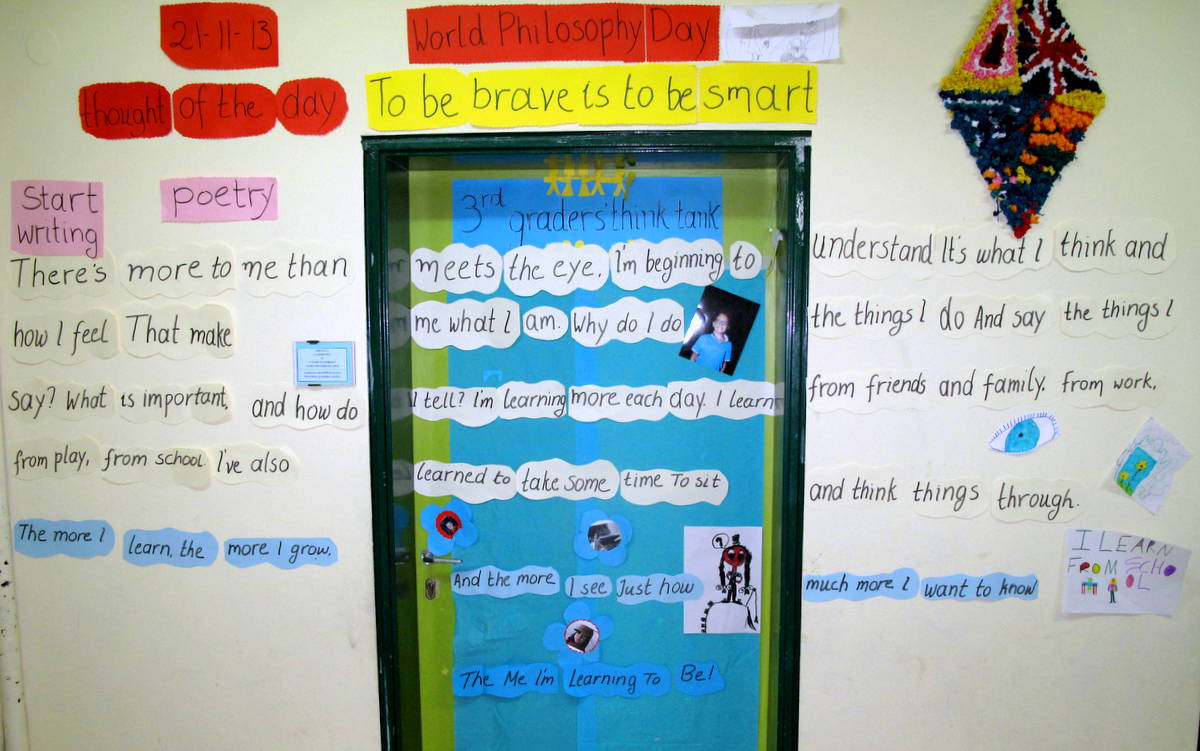
Photo of classroom door with poem

News on the School of European Education Heraklion

Disclaimer: I am writing here as a parent of three students at the School of European Education Heraklion. The views expressed are mine and are not intended to represent those of the school’s teachers, management, or PGA.

Since my blog post on Philhellenes about the School of European Education in Heraklion I have received many messages from parents who are thinking of sending their children to the school and who want to know my views about its future. Naturally, they want reassurance that its future is secure before they make a commitment. I have replied to most of these privately, but I thought it might be helpful to make a general statement here.

The first thing to say is that I am delighted to have received so many messages. This in itself confirms what all the school’s parents and teachers already know – namely, that there is wide interest in the school and strong support for it.

As to the future of the school, I’m simply not sure. The school has a lot of potential, but there is uncertainty at the moment. To some extent, this is a sign of the times in Greece. Currently, almost everything here is uncertain. But it is not only that. Despite the positive attitude from students, teachers, parents, school management, and European inspectors, there is a sense that the school is not sufficiently supported by the regional and national authorities.

Whether or not this is the case, it makes sense to think that the school will be kept open if it is seen to fulfill a need. I don’t just mean the needs of ENISA (the European Network and Information Security Agency, which is based in Heraklion and with which the school is associated). Heraklion is a large and cosmopolitan city, and there are many families here who, for one reason or another, would like to send their children to an international school.

However, there is a vicious circle here. We need more students to register in order to secure the school’s future, but parents are reluctant to register their children while the school’s future is uncertain. Insecurity lowers registrations, and lower registrations increase insecurity. So I would ask you to keep registering your children. The school has vacancies and would love to welcome new students. I can’t promise you that the school’s future is secure, but you can help its prospects by making a commitment to it. Certainty will come from within!

Now for some news. Last term the school underwent inspection by the European Schools inspectorate, and their draft report was supplied to parents this week. It contains good news and bad news.

The inspectors praised the dedication of the school management and teachers and remarked on the school’s warm pedagogical atmosphere and stimulating learning environment. They commended the structure of lessons, the use of ICT, and the range of extra-curricular activities provided. They noted that students are very positive about the school, feel privileged to be part of it, and believe it will give them a good start at university. They praised the school for its openness and for taking the lead in local cultural and regional projects and for building contacts with other schools across Europe. This part of the report makes very encouraging reading indeed.

However, the inspectors also highlight some serious problems which they want to see resolved as a matter of urgency. They highlight three issues: (1) Lack of continuity for teachers, who are on yearly contracts only, (2) Low pupil numbers, especially in the English section, and (3) The school building, which is not large or well-equipped enough for a school of this type.

The inspectors note that these problems seriously threaten the existence of the school.

Clearly, these are not issues the school management and teachers can resolve; they are matters for the regional and national authorities. The inspectors urge the Greek authorities to find solutions and save the school.

The inspectors go on to make six specific recommendations, concerning teacher recruitment and contracts, student enrolment, the relationship with ENISA, and other matters — all with the aim of addressing the problems identified. They indicate that the future of the school depends on these recommendations being accepted and implemented by the Greek authorities.

Where does this leave us? Well, it leaves us with an excellent school which desperately needs support: support from politicians, from parents, and from the community. The SEE is a precious resource for Heraklion and Greece, and we must all act now if we are to save it and safeguard its future. If you support the school, please join with the parents and teachers in lobbying the government to implement the inspectors’ recommendations.

And if are you thinking of registering your children with the school, please do it. Perhaps the biggest factor in all this is student numbers, and increasing registrations at the school is the best way to help it. Yes, there is some uncertainty, but if you wait for the uncertainty to end then you may lose the chance altogether. (And you can always change your mind later if things don’t work out.) So please, act now!

Thanks again to all those who have written to me, and apologies to anyone to whom I haven’t replied (life has been hectic recently). I hope to see you in school either as a fellow parent or as a teacher of your children.

Update: My partner has created a petition calling on the authorities to save the SEEH. If you support the school, please sign the petition and share it.

PS. A note on the school building: There are already plans to construct a new school building on land supplied by the University of Crete, and in 2012 the School Buildings Organisation of Greece ran an architectural competition for the design of the building (here are details of the competition and prize winners). The winning design looks excellent. However, work on the project has still not begun. The decision to move forward lies with the authorities.

Photo of classroom door with poem